
REST API vs GraphQL: Complete Comparison
Understand REST API and GraphQL trade-offs across flexibility, payload control, tooling, caching, and frontend developer experience before choosing an API style.
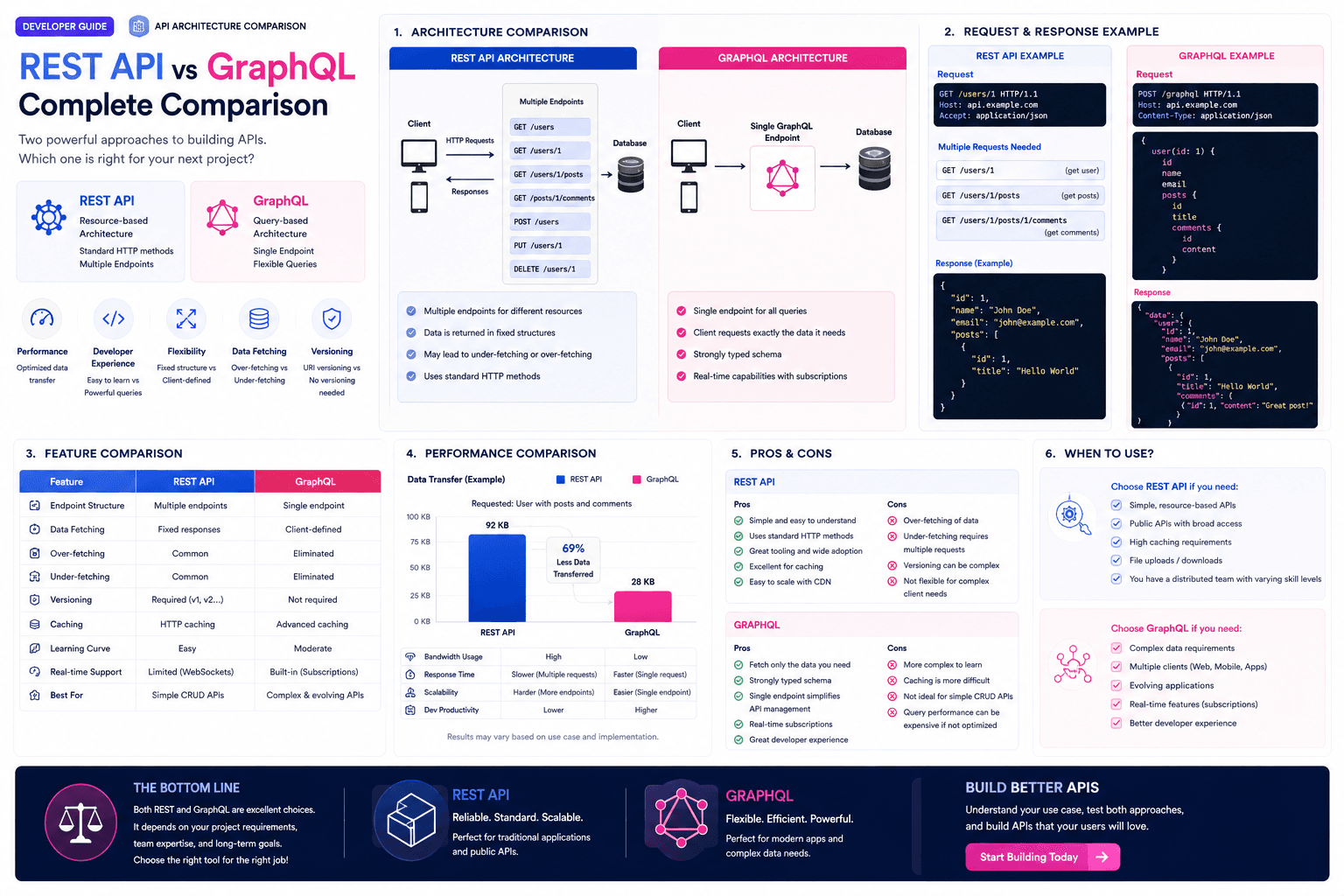
Overview
REST and GraphQL are both valid ways to expose data, but they optimise for different concerns. REST offers familiar resource-based endpoints, while GraphQL gives clients more control over exactly what data they request.
Technology choices should follow the product goal. Frameworks, databases, APIs, and infrastructure are valuable only when they make the system faster, safer, easier to maintain, and easier for users to trust.
Why It Matters
API style affects frontend complexity, backend modelling, caching, and team workflow. Choosing well early can reduce product friction; choosing poorly can add unnecessary overhead.
Choose based on product data needs, team skill, and operational simplicity. If flexibility is not a major problem, do not add GraphQL complexity just because it sounds modern.
Examples In Practice
A mobile app that needs data from several related entities in one screen may benefit from GraphQL because it can request a shaped response without hitting multiple REST endpoints.
A straightforward CRUD business tool with predictable data patterns may stay simpler with REST because the endpoints are easy to reason about, monitor, and document.
What A Good Decision Looks Like
The right answer is rarely the most complicated version of rest api vs graphql: complete comparison. A sensible decision starts with the problem people are experiencing today, the outcome the business needs, and the constraints around budget, data, team capacity, and timing. This makes it easier to separate a useful investment from a feature that only sounds impressive in a planning meeting.
Before committing, write down what success should look like in day-to-day work. It could be quicker lead follow-up, fewer support handoffs, clearer reporting, a smoother buying journey, or less time spent correcting errors. Give that outcome an owner and a simple baseline so the team can compare the result after launch instead of relying on instinct alone.
It also helps to speak with the people who will use the system every day. They usually know which exceptions matter, where information goes missing, and which shortcuts keep work moving. Bringing that context into discovery produces a more practical solution and makes adoption much easier once the work goes live.
How To Approach It
A good implementation begins with a short discovery phase. Map the current process from the first trigger to the final outcome, including the people involved, existing tools, data quality, approval points, and the moments where work slows down. This gives the project a shared source of truth before design or development begins.
From there, shape the work into a realistic roadmap: define the smallest valuable version, design the user flow, build and test it with real scenarios, launch carefully, and improve from evidence. A phased approach protects the budget, reveals issues earlier, and avoids spending months on features that do not change the business outcome.
Keep a human review path for important decisions, especially where money, customer commitments, or sensitive information is involved. Clear ownership, useful reporting, and regular feedback after launch are what turn a one-time project into a system the team can depend on.
- Start with the business outcome before choosing tools.
- Map the current workflow, users, data, risks, and approval points.
- Build a focused version first, then improve from real usage.
- Measure speed, conversion, reliability, support load, and operational savings.
- Keep the system maintainable with clear architecture and documentation.
Where STEXRA Can Help
STEXRA tends to recommend the API style that keeps product delivery and maintenance clearer for the client’s actual frontend and backend needs.
STEXRA can help with API Development, GraphQL, REST API, and related work such as AI workflow automation, website design, web application development, custom software development, API development, and business automation.