
How AI Automation Can Save Businesses 100+ Hours Every Month
See how businesses save 100 or more staff hours a month by automating lead handling, reporting, support triage, and back-office coordination instead of scaling manual admin.
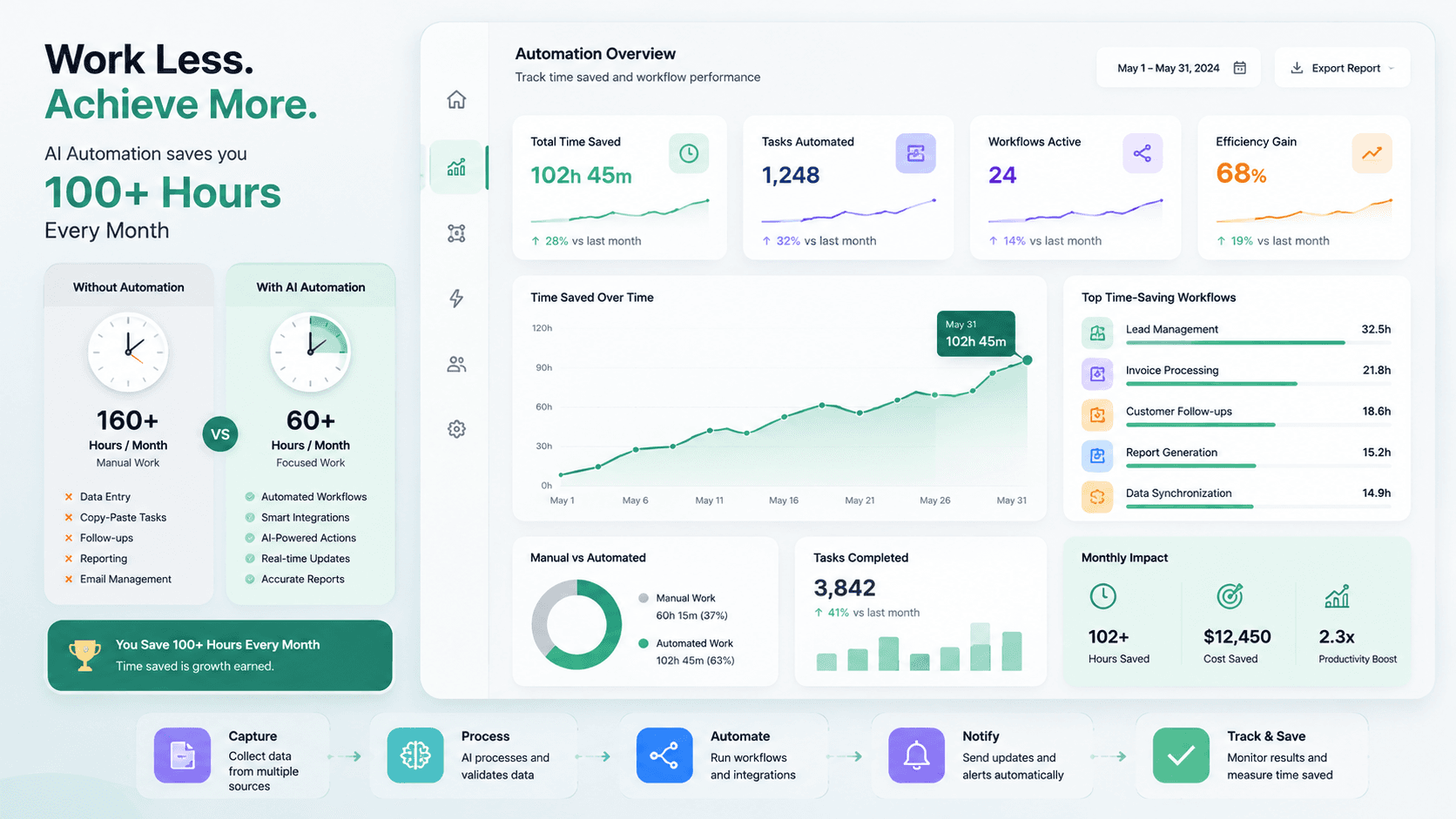
Overview
Saving 100 hours a month rarely comes from one dramatic automation. It usually comes from removing 10 to 20 minutes of repeated admin from dozens of daily actions across sales, support, finance, and operations.
AI automation is most useful when it removes repeatable work, improves response time, and keeps important decisions visible to people. Strong automation starts with workflow mapping, clean inputs, guardrails, and measurable outcomes.
Why It Matters
If a five-person team loses one hour a day each to status updates, copying records, and answering the same internal questions, that is roughly 100 hours a month of recoverable time. Reclaiming that capacity is often cheaper than hiring for the same work.
Measure time loss by workflow, not by department. Add up how long each repeated task takes, how often it occurs, and how many people touch it before deciding what to automate first.
Examples In Practice
A service business receiving 25 enquiries a day can automate lead qualification, proposal scheduling, and WhatsApp reminders, turning a 3-hour admin block into a monitored background workflow.
A reporting automation that combines data from ads, CRM, and billing can replace four separate spreadsheets and save managers from spending every Monday rebuilding the same dashboard.
What A Good Decision Looks Like
The right answer is rarely the most complicated version of how ai automation can save businesses 100+ hours every month. A sensible decision starts with the problem people are experiencing today, the outcome the business needs, and the constraints around budget, data, team capacity, and timing. This makes it easier to separate a useful investment from a feature that only sounds impressive in a planning meeting.
Before committing, write down what success should look like in day-to-day work. It could be quicker lead follow-up, fewer support handoffs, clearer reporting, a smoother buying journey, or less time spent correcting errors. Give that outcome an owner and a simple baseline so the team can compare the result after launch instead of relying on instinct alone.
It also helps to speak with the people who will use the system every day. They usually know which exceptions matter, where information goes missing, and which shortcuts keep work moving. Bringing that context into discovery produces a more practical solution and makes adoption much easier once the work goes live.
How To Approach It
A good implementation begins with a short discovery phase. Map the current process from the first trigger to the final outcome, including the people involved, existing tools, data quality, approval points, and the moments where work slows down. This gives the project a shared source of truth before design or development begins.
From there, shape the work into a realistic roadmap: define the smallest valuable version, design the user flow, build and test it with real scenarios, launch carefully, and improve from evidence. A phased approach protects the budget, reveals issues earlier, and avoids spending months on features that do not change the business outcome.
Keep a human review path for important decisions, especially where money, customer commitments, or sensitive information is involved. Clear ownership, useful reporting, and regular feedback after launch are what turn a one-time project into a system the team can depend on.
- Start with the business outcome before choosing tools.
- Map the current workflow, users, data, risks, and approval points.
- Build a focused version first, then improve from real usage.
- Measure speed, conversion, reliability, support load, and operational savings.
- Keep the system maintainable with clear architecture and documentation.
Where STEXRA Can Help
STEXRA focuses on workflows where time savings are obvious on paper and visible after launch, so the business can link automation effort to staffing, response speed, and operating margin.
STEXRA can help with AI Automation Company India, Business Automation, Automation Agency, and related work such as AI workflow automation, website design, web application development, custom software development, API development, and business automation.