
Business Process Automation: Complete Guide
Understand business process automation end to end, including workflow mapping, software choices, handoff design, and how to reduce manual effort without losing visibility.
Overview
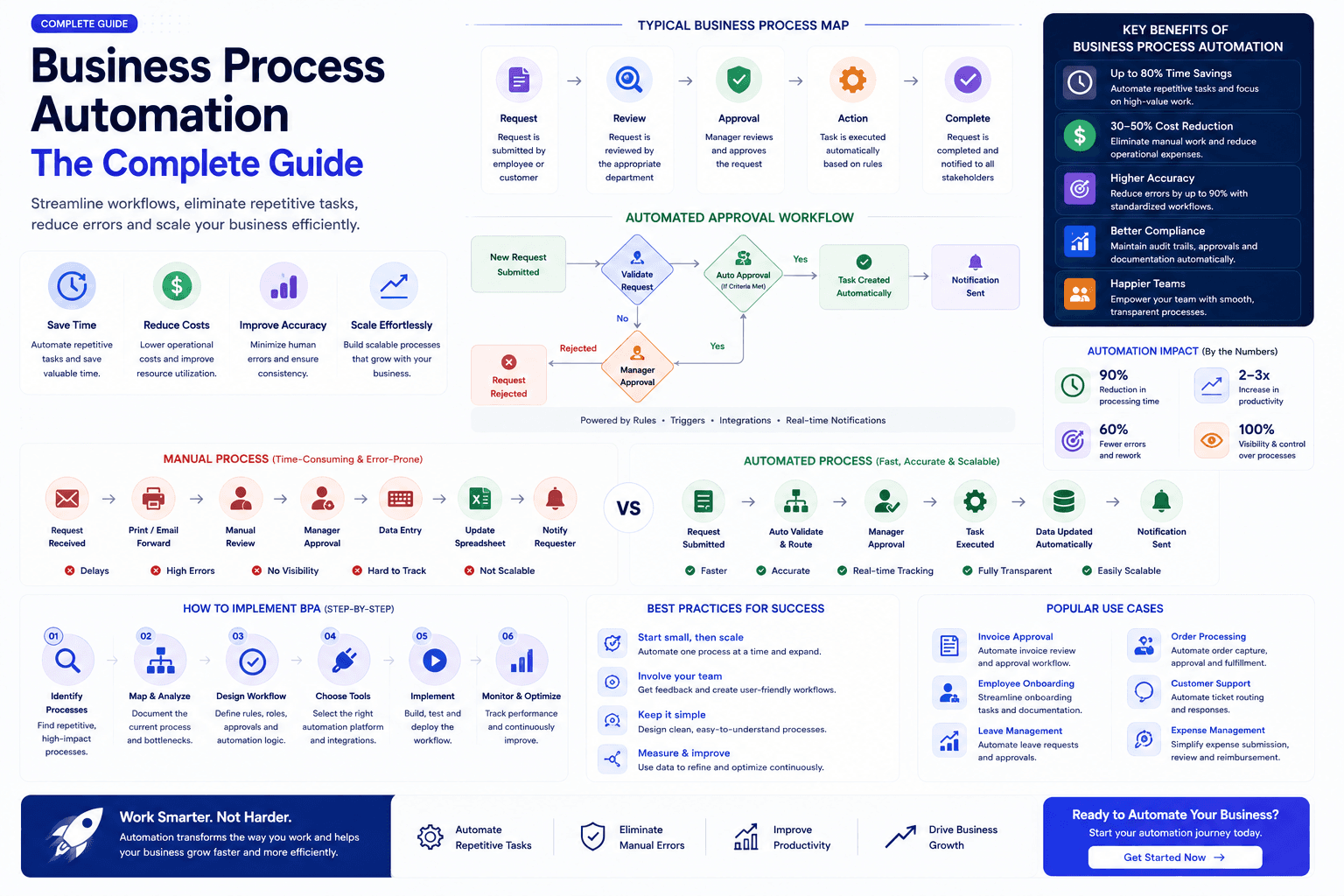
Business process automation means turning repeatable operational steps into structured digital workflows. The aim is not to automate everything, but to make recurring work move with less chasing, less duplication, and better accountability.
Business automation connects routine tasks across forms, CRMs, email, WhatsApp, databases, dashboards, and internal tools. The goal is to reduce manual effort while keeping quality and accountability high.
Why It Matters
As a business grows, delays often appear between departments rather than inside one task. Automation helps most when it connects those handoffs and makes status visible without constant follow-up.
Map the current process visually, identify repeatable decisions, and decide where approvals or exception handling still need humans. That prevents brittle automation.
Examples In Practice
A sales-to-operations handoff can automatically create a project record, assign onboarding tasks, and notify the delivery team when a deal closes instead of relying on manual forwarding.
A finance approval workflow can route bills by department and amount threshold so managers review only the items relevant to them, reducing bottlenecks in month-end processing.
What A Good Decision Looks Like
The right answer is rarely the most complicated version of business process automation: complete guide. A sensible decision starts with the problem people are experiencing today, the outcome the business needs, and the constraints around budget, data, team capacity, and timing. This makes it easier to separate a useful investment from a feature that only sounds impressive in a planning meeting.
Before committing, write down what success should look like in day-to-day work. It could be quicker lead follow-up, fewer support handoffs, clearer reporting, a smoother buying journey, or less time spent correcting errors. Give that outcome an owner and a simple baseline so the team can compare the result after launch instead of relying on instinct alone.
It also helps to speak with the people who will use the system every day. They usually know which exceptions matter, where information goes missing, and which shortcuts keep work moving. Bringing that context into discovery produces a more practical solution and makes adoption much easier once the work goes live.
How To Approach It
A good implementation begins with a short discovery phase. Map the current process from the first trigger to the final outcome, including the people involved, existing tools, data quality, approval points, and the moments where work slows down. This gives the project a shared source of truth before design or development begins.
From there, shape the work into a realistic roadmap: define the smallest valuable version, design the user flow, build and test it with real scenarios, launch carefully, and improve from evidence. A phased approach protects the budget, reveals issues earlier, and avoids spending months on features that do not change the business outcome.
Keep a human review path for important decisions, especially where money, customer commitments, or sensitive information is involved. Clear ownership, useful reporting, and regular feedback after launch are what turn a one-time project into a system the team can depend on.
- Start with the business outcome before choosing tools.
- Map the current workflow, users, data, risks, and approval points.
- Build a focused version first, then improve from real usage.
- Measure speed, conversion, reliability, support load, and operational savings.
- Keep the system maintainable with clear architecture and documentation.
Where STEXRA Can Help
STEXRA usually combines workflow logic, dashboards, and integrations so businesses gain both speed and better process visibility after automation goes live.
STEXRA can help with Business Automation, Automation Agency, AI Workflow Automation, and related work such as AI workflow automation, website design, web application development, custom software development, API development, and business automation.